Antigua & Barbuda
Antigua, at just just one hundred eight square miles in total area, is the largest of the Leeward Islands. Discovered by Christopher Columbus in 1493 for the Spanish Crown, Spain never colonized it. After settling St. Cristophe in 1623 and being its first governor from 1624 until his death in 1649, Sir Thomas Warner (1580-1649) settled Antigua in 1632 becoming its first governor from 1632 to 1635, succeeded by his son Edward Warner from 1635 to 1639. Antigua formally became an English colony in 1667.
In the early days of colonization, the British settlers of Antigua planted indigo, cotton, tobacco, ginger and sugarcane. Within a few decades, all other crops were phased out in favor of sugarcane which by 1672 accounted for almost half of the Leeward Islands sugar production. By the year 1700, more than half of the land in Antigua was planted with sugarcane, giving rise to two hundred plus sugar plantations established by British owners who, contrary to Barbados and St. Kitts where families that arrived in the early to mid 1600s remained for generations, did not remain on the island permanently and became absentee owners continuing to live in Great Britain.
The first large scale sugar plantation in Antigua was established in 1651 by Christopher Keynell who became the island’s colonial governor from 1652 to 1660. Upon his death in 1663, his plantation was inherited by his widow Dame Joan Hall, who had to flee Antigua due to the French occupation of the island from 1666 to 1674. When the British regained control of Antigua, the British Parliament annulled all prior land claims of those who had fled the island. King Charles II then gave the property to Barbados resident at the time Col. Christopher Codrington (ca. 1640-1698) who renamed the property Betty's Hope in honor of his daughter. Beginning around 1671, sugar mills powered by wind started to appear in Antigua’s landscape, by 1870 there were approximately one hundred seventy windmills in an island of one hundred eight square miles, each the center of a sizable plantation. A good number of the many stone towers characteristic of windmills then built still remain, this Google Map show their location.
In 1684, King Charles II granted a renewable fifty year lease on the island of Barbuda to Col. Codrington who used the smaller island to cultivate provisions for his estate in Antigua. The whole island of Barbuda was but a big plantation and was never developed, Col. Codrington’s family held control of Barbuda until 1860 when it was annexed to Antigua. In 2017 Hurricane Irma missed Antigua but pummeled Barbuda pretty much flattening it. All Barbudans were evacuated to Antigua and the island has never recovered from the devastation.
The rise of the American colonies in 1776 played an important role in the decline in trade between the thirteen colonies and the West Indies. Previous to the establishment of the thirteen Colonies, the West Indies relied heavily on trade with North America, but the colonials believed in free trade and established important export and import business with French and Spanish islands as well as British. Steam power was introduced in Antigua around 1845 and by the end of the century the central sugar mill concept took over all sugar production. Towards the end of the 19th Century and the beginning of the 20th Century when the sugar industry evolved into the central sugar mill concept, the following three central sugar mills were established in Antigua:
Montpelier Sugar Factory - established in 1890 and operated until 1954 when it closed down due to labor problems after the 1954 crop, was considered one of the finest muscovado sugar factories in the Caribbean in the 1890’s, was acquired by Antigua Distillery Ltd. in 1934 to produce molasses for its rum distillery
Bendals Sugar Factory - established in 1904 in St. John's Parish in what used to be Belvidere, it was closed and dismantled in 1940, the sugar factory on this estate no longer exists but remains of other structures like the manager’s house, several stone walls of the old sugar factory, tennis court and the foundation stones of several of the staff houses still stand.
The Antigua Sugar Factory - in the mid-1890s, sugar production in Antigua dropped precipitously, fact that coupled with a new low in sugar prices and the closing of the US market, sent the Antiguan economy into a deep depression. In 1896, following the recommendations of a Royal Commission (generally referred to as the Norman Commission), the Colonial Office [1] agreed to help finance a central sugar mill. In December 1904 a grant was given to British company Henckell DuBuisson & Co. who established the Antigua Sugar Factory in what used to be Gunthorpe’s Sugar Factory in St. George's Parish. It was the largest central sugar mill on the island until it closed in 1972 when its machinery, equipment and locomotives were sold, some to St. Kitts. In 1982 the Antigua Sugar Industry Corp. was formed in order to enable the government to purchase machinery and restart the factory, which they did in 1982 with the help of the Barbados Sugar Industry Ltd. The Antigua Sugar Industry Corp. operated the sugar mill until 1988 when it closed permanently.
In 1967 Antigua became an associated state of the British Commonwealth and in 1981 achieved full independence. Antigua & Barbuda as the island nation is formally known, is a founding member of the Organization of Eastern Caribbean States, an economic union created to adopt a common approach to trade, health, education and the environment, as well as the development of critical sectors such as agriculture, tourism and energy. In 1969 the Parliament of Antigua and Barbuda a bill to borrow EC$5.6 million from the Royal Bank of Canada to purchase the Antigua Sugar Factory and the Antigua and Barbuda Syndicate Estates Ltd. both of which combined owned a vast majority of the sugar estates on the island which included some 33,000 acres of arable land, beach land, estate houses and the sugar mill.
In 1972 sugar ceased to be the major export commodity and the sugar industry the largest employer in Antigua, ending over three centuries of history. Today there are some remains of two of the three central sugar mills and over one hundred windmills that still remain standing. Some of the old picturesque stone windmills that remain have or are still being used as houses, bars, restaurants and shops. Bucknell University’s Griot Institute’s Antigua Sugar Mills Project has an excellent website titled Antigua Sugar Mills documenting the research work of Antigua native Agnes Meeker on the sugar mills and plantations on the island. The website lists and includes maps and a brief history of the many sugar plantations that existed in Antigua, including those for which no remains are left. The book Plantations of Antigua: The Sweet Success of Sugar by Agnes C Meeker with Donald A Dery is a very interesting read about the history and development of the sugar industry of Antigua and some of its better known plantations.
_________________________________________________________________
[1] The Colonial Office, based in London, managed affairs to keep the colony financially solvent, the local administrative hub was the Government House in St. John’s.
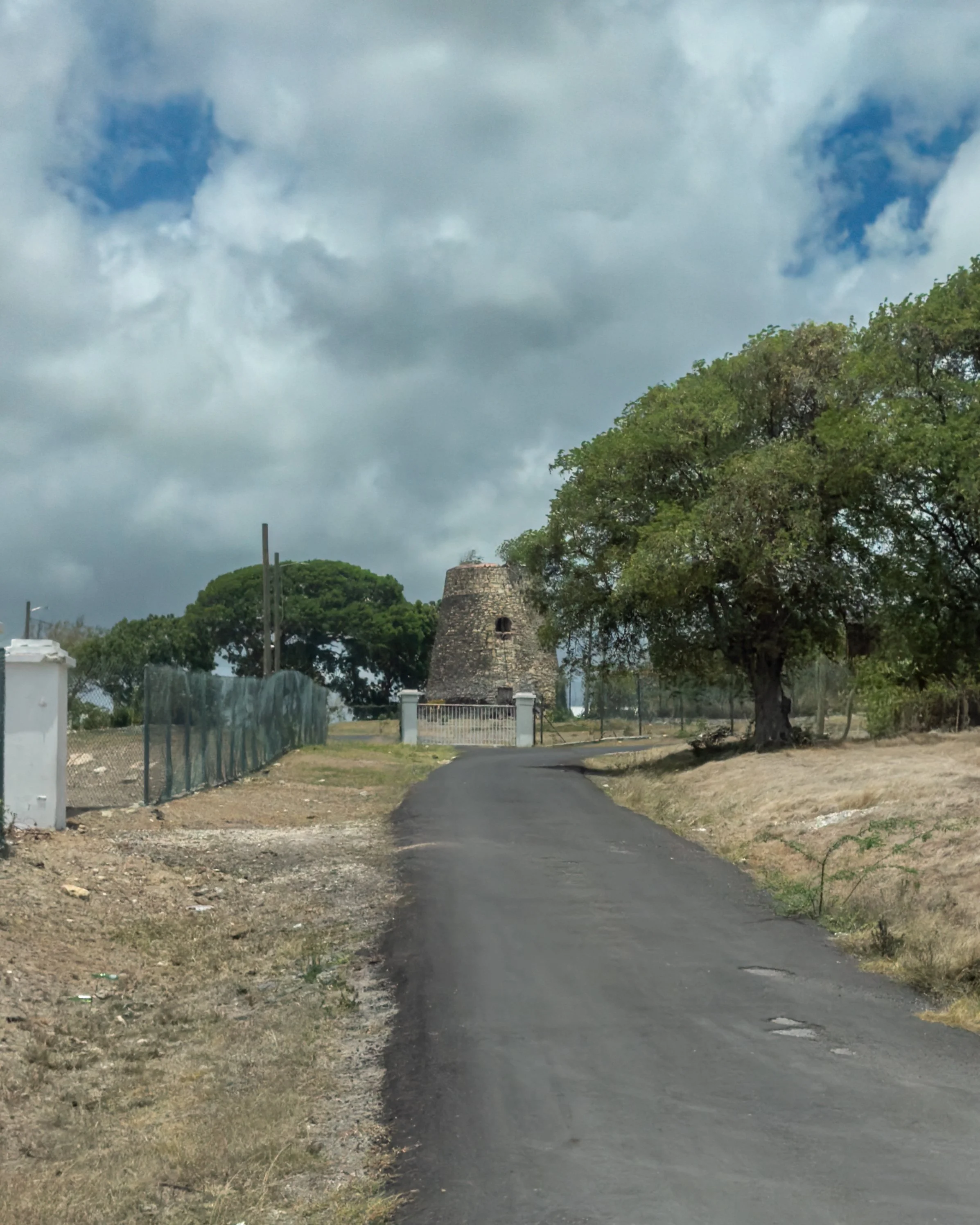
Windmill at the Tomlinson Estate, a large scale sugar cane plantation that converted to steam in the mid-1800s and later integrated into the agricultural operations of the Antigua Syndicate Estates, Ltd no on the grounds of The Harrison Centre of the Antigua and Barbuda Institute of Continuing Education
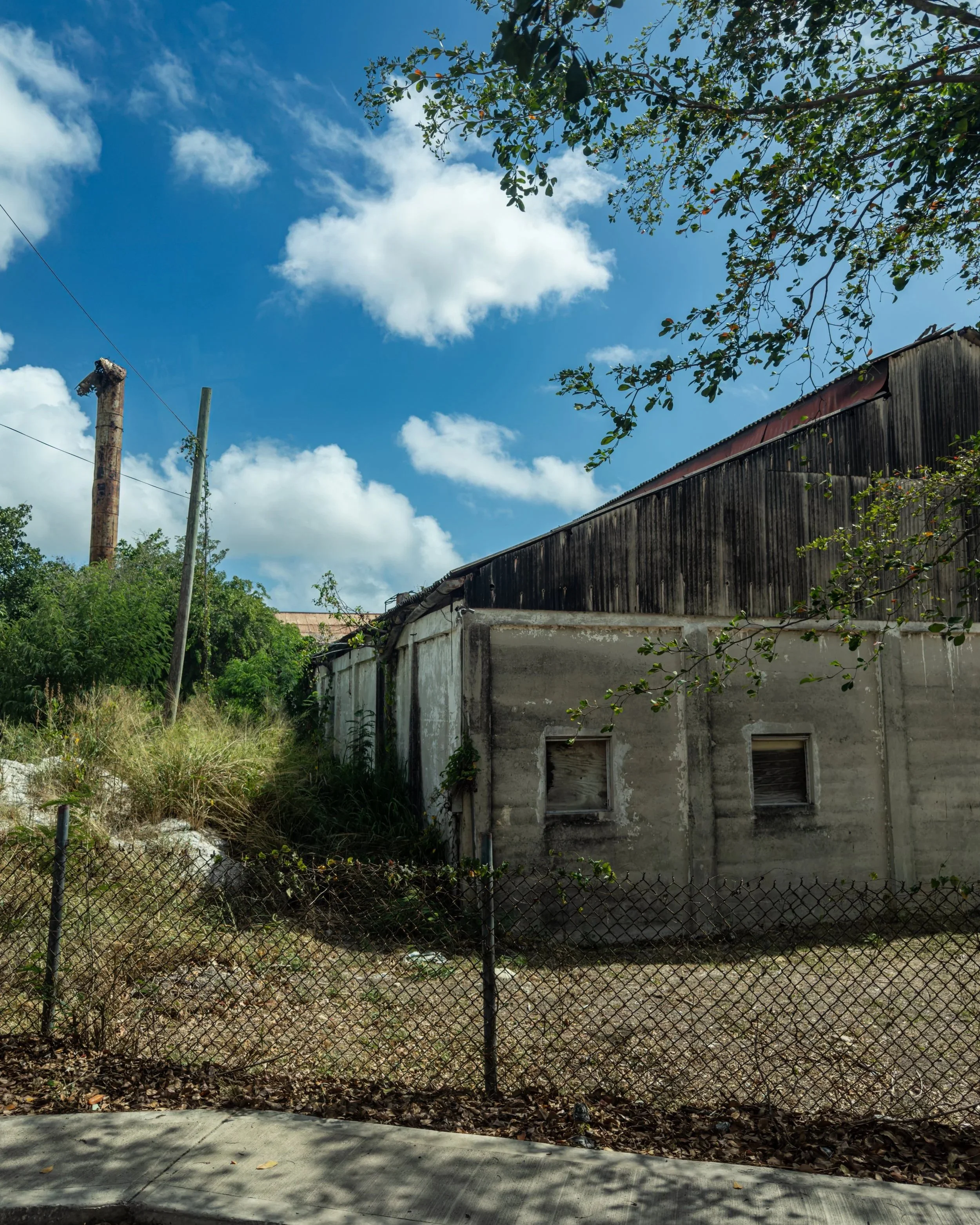
Road view of chimney and remains of Gunthorpe's Sugar Factory
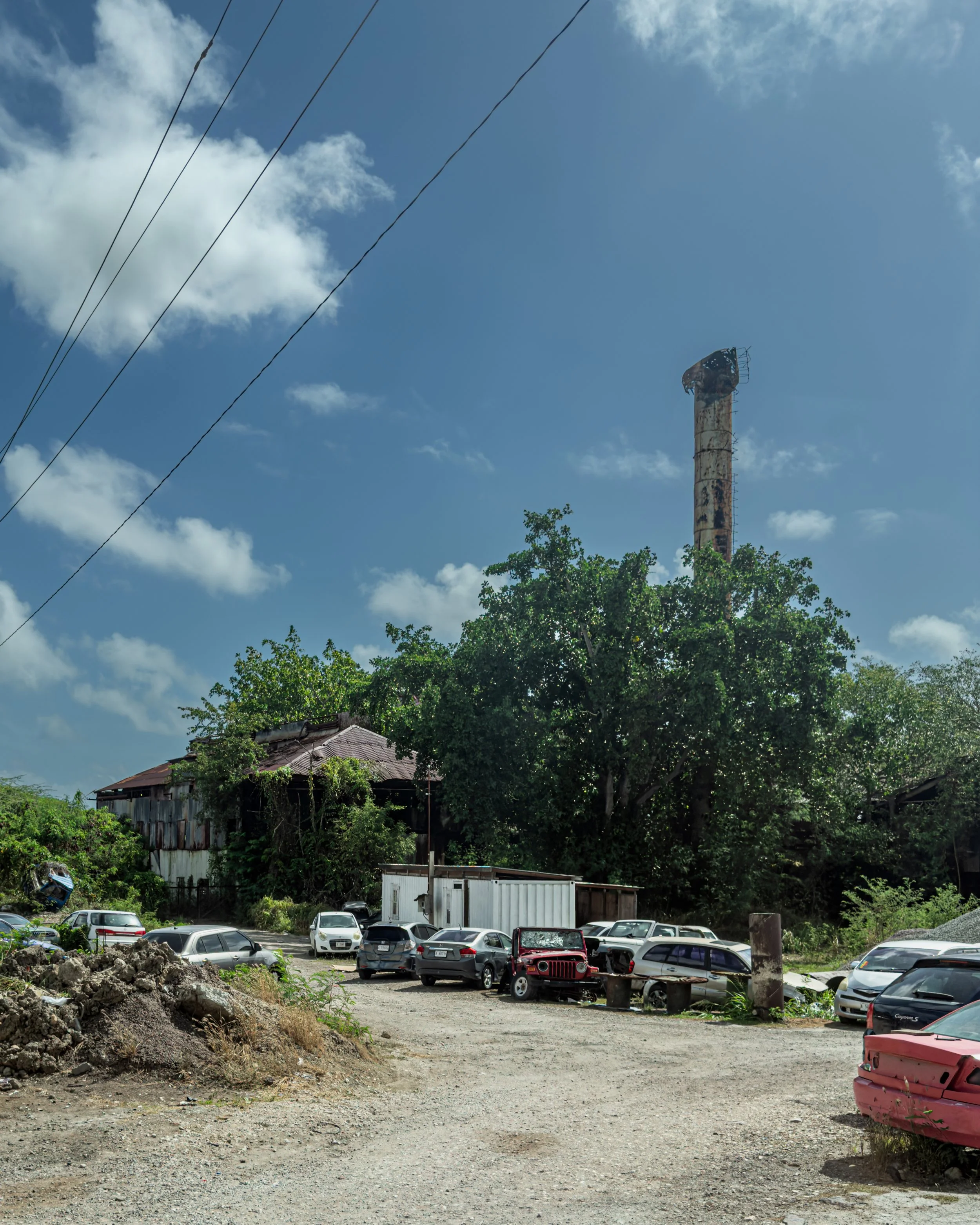
Road view of chimney and remains of Gunthorpe's Sugar Factory